

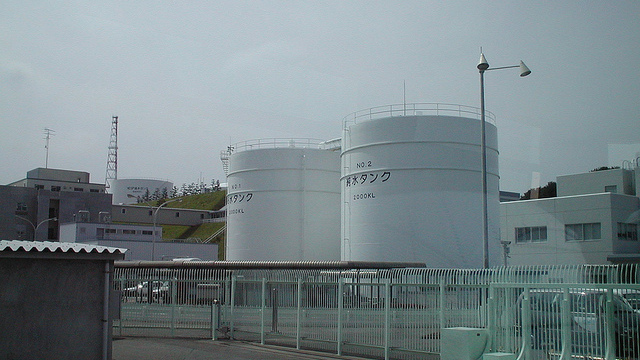
In what’s being described as a rare win for anti-nuclear activsts, a Japanese court has ruled against a move to restart two reactors at the Ohi nuclear power plant, west of Tokyo, owned by the Kansai Electric Power Co.
According to Reuters:
Ohi, like all of Japan’s nuclear plants, has been idled for safety checks in the wake of the 2011 disaster at Tokyo Electric Power Co’s (9501.T) Fukushima Daiichi plant pending safety checks.
The court ruling is likely to be another spanner in the works for the return to operations of reactors, with the safety checks bogged down by paperwork and disputes over interpreting new guidelines.
“Plaintiffs have rarely won. This is right in the middle of the restart process … it could have very well have repercussions,” said Aileen Mioko Smith, executive director of Green Action, which earlier this month had a lawsuit to close the Ohi reactors rejected by a court in Osaka.
National broadcaster NHK said it was the first time anti-nuclear campaigners had won a court ruling against nuclear power, but Smith said there had been two other rulings by courts supporting plant closures.
Those rulings were eventually overturned by higher courts in favor of nuclear operators, she said.
Calls to Fukui District Court went unanswered. Anti-nuclear campaigners were seen on NHK celebrating the ruling.
And the Asahi Shimbum newspaper adds:
The lawsuit’s biggest point of dispute was whether an earthquake whose tremors exceed the safety standard could actually occur in the future.
The plaintiffs said that, since 2005, there have been five cases in which the tremors exceeded the predicted standard, including the instance of the Fukushima No. 1 nuclear power plant at the time of the Great East Japan Earthquake. Therefore, they claimed that Kansai Electric’s estimate of the maximum potential earthquake is too optimistic.
In response, Kansai Electric explained that the maximum possible earthquake vibration in the compound of the Oi nuclear power plant is 700 gals of ground acceleration. It also claimed that even if vibrations of 759 gals were to occur, functions of key facilities could be maintained.
There were also three other points in dispute. One was whether nuclear reactors can be continued to be cooled even if all outside power sources are lost. Another was whether leakage of radioactive materials can be prevented when pools storing spent nuclear fuel rods are damaged. And the third was whether ground slippage could occur due to the movement of active faults or landslides.
Based on the three points, the plaintiffs contended that the Oi nuclear plant is dangerous. However, Kansai Electric disagreed, arguing that it has already taken sufficient measures concerning those concerns.
This article originally appeared in Common Dreams.