

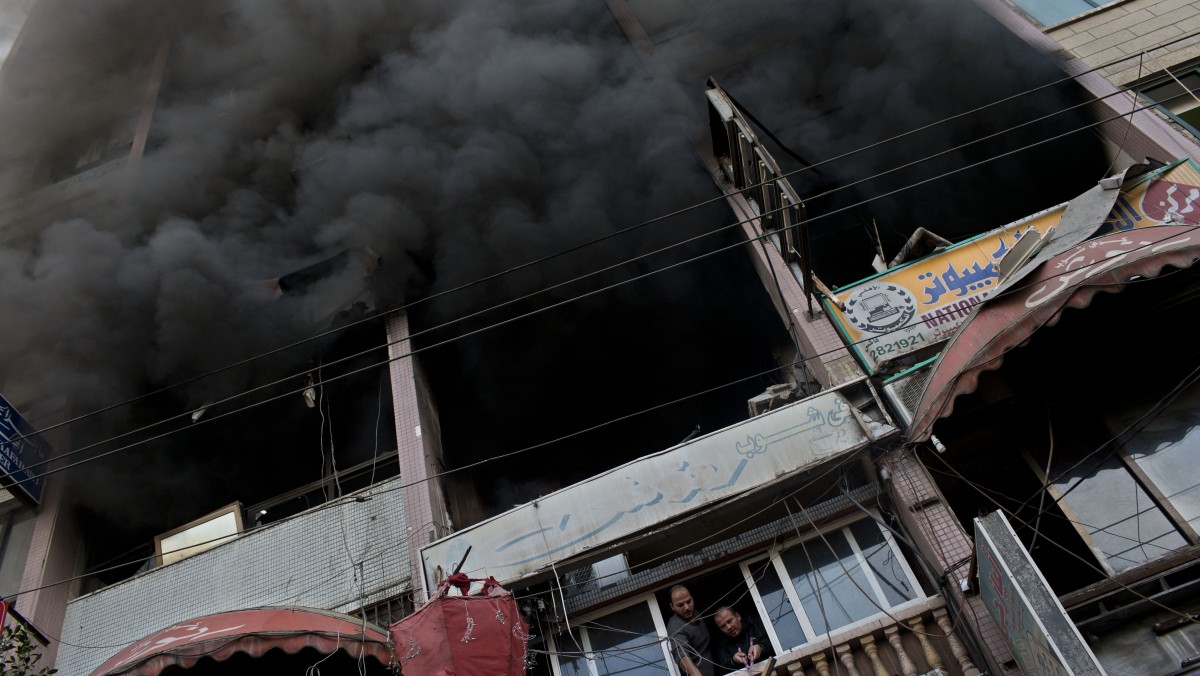

(NEW YORK) MintPress – As the flurry of military and diplomatic activity in the Middle East intensifies, both sides in the Gaza conflict have been embracing social media as one of their tools of warfare. Hamas is active on twitter, while the Israeli Defense Forces (IDF) have established a presence on several platforms.
Third parties are also joining in: The Israeli government released figures showing that hackers have made more than 44 million attempts on its websites since the offensive in Gaza began almost a week ago.
It said that the greatest number of attempts had been made on defense-related sites, while 10 million had been made on the site of the Israeli president, 7 million on the country’s foreign ministry and 3 million on the site of the prime minister.
International cyber activist group Anonymous has posted a list of nearly 700 Israeli websites it claims it has targeted and disrupted in response to the airstrikes.
It also issued a statement calling on other hackers to help disable websites associated with or belonging to the Israeli government or military.
Most of the sites that were hacked appeared to be unavailable, but some displayed pro-Palestinian images and messages.
A government spokesman said that while the attacks have come from around the world, most have been from Israel and the Palestinian territories.
“The war is taking place on three fronts. The first is physical, the second is on the world of social networks and the third is cyber,” said Israel’s chief information officer, Carmela Avner.
Reporting in real time
Social media has also changed the way the media has covered the conflict. NBC News correspondent Ayman Mohyeldin told the Huffington Post it’s a “completely different dynamic” reporting from Gaza now than it was four years ago, when the IDF launched a three-week aerial bombardment and ground invasion that killed 1,400 Palestinians.
Speaking by phone Monday from Gaza City, Mohyeldin said “there was a dearth of information and pictures” as a result of so few journalists on the ground. “We couldn’t be everywhere at the same time.”
Now, with the Israeli military no longer restricting foreign journalists from entering Gaza, news organizations have been flooding in and journalists are reporting each major strike in real time on Twitter.
After Monday’s strike on a media center in Gaza, for example, BBC Middle East bureau chief Paul Danahar tweeted that Israel struck a building used by some outlets. “I’m standing in front of it,” he said. “It’s on fire. Smoke billowing out.”
Soon after, NBC News chief foreign correspondent Richard Engel tweeted a picture of the building and noted that it housed Hamas TV and other offices. And CNN senior international correspondent Arwa Damon tweeted that one person had died and five were injured in the strike.
The official IDF spokesperson Twitter account quickly confirmed and defended the strike. “A short while ago, the IDF targeted a cadre of senior Palestinian Islamic Jihad operatives who were hiding in a media building in #Gaza,” it tweeted
In a follow-up tweet, it reported, “A direct hit was identified on the target. Four senior members of Palestinian Islamic Jihad were known to have been in the media building.”
The AP later sent a video of the attack over the wire, while CNN aired footage of it just before a live-shot with Anderson Cooper, who is also tweeting updates from Gaza to his 3.3 million Twitter followers.
Al Jazeera English also reported on the strike Monday, noting that the building is used by several outlets, including Britain’s Sky News, Saudi-owned Al Arabiya and Hamas broadcaster Al Aqsa TV.
In covering a situation like Gaza, said Moyheldin, “Viewers will benefit when there are more journalists inside.”
Public opinion
It’s not yet clear how the outpouring of information has impacted all of those viewers. In the annual BBC Country Ratings Poll, published exactly a week before the IDF assault began, Israel was ranked among the most unpopular countries in the world.
With 50 percent of respondents ranking Israel negatively, the country is on a par with North Korea and places ahead of only Iran (55 percent negative) and Pakistan (51 percent negative).
The poll was conducted among 24,090 people worldwide and asked respondents to rate whether the influence of 22 countries was “mostly positive” or “mostly negative.”
People viewing Israel negatively cited its foreign policy as the main factor influencing their perception, while those who view Israel positively cited culture and Jewish traditions.
The poll found that negative perceptions of Israel in EU countries have remained stable or continued to rise, while among Muslim countries, perceptions of Israel have continued to deteriorate, especially in Egypt, where 85 percent of the population views Israel negatively, up 7 percent since 2011. In Asian countries, as well as in Australia and New Zealand, public opinion on Israel is increasingly antagonistic.
In the United States, though, the poll found that the proportion of people viewing Israel negatively has decreased six points to 35 percent, representing the most positive views on Israel expressed here since tracking began in 2005.
Meanwhile, a CNN/ORC International poll released Monday indicates that 57 percent of the American public says Israel is justified in taking military action against Hamas in Gaza, with 1 in 4 saying the attacks are unjustified.
The CNN survey was conducted by ORC International from Nov. 16-18, with 1,023 adult Americans questioned by telephone.
“Although most Americans think the Israeli actions are justified, there are key segments of the public who don’t necessarily feel that way,” said CNN Polling Director Keating Holland.
“Only four in ten Democrats think the Israeli actions in Gaza are justified, compared to 74% of Republicans and 59% of independents. Support for Israel’s military action is 13 points higher among men than among women, and 15 points higher among older Americans than among younger Americans.”
Meanwhile, U.S. Secretary of State Hillary Clinton is set to arrive in the Middle East from Southeast Asia, where she was traveling with President Obama, to try to find an immediate solution to the latest crisis on the ground.