

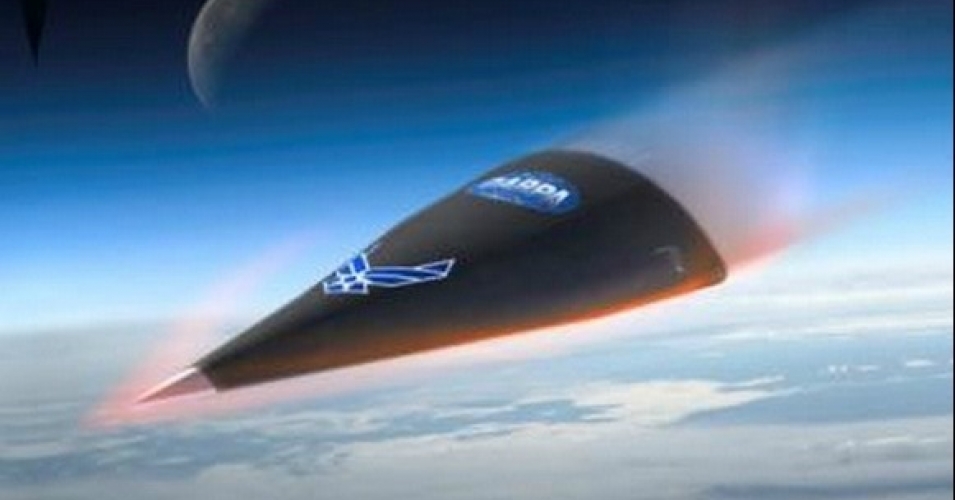
The U.S. military is taking the global arms race to new speeds, with the second test launching of an Advanced Hypersonic Weapon that has the ultimate aim of hitting targets anywhere on earth within an hour by traveling up to five times the speed of sound.
But the test, which took place Monday at the Kodiak Launch Complex in Alaska, was cut short by an unspecified failure in the device, which exploded just seconds after taking off. “Due to an anomaly, the test was terminated near the launch pad shortly after lift-off to ensure public safety,” the Department of Defense announced in a press release. “There were no injuries to any personnel.”
The explosion follows a prior 2011 successful launch of the weapon, which was developed by Sandia National Laboratories, which is a subsidiary of Lockheed Martin Corporation and a contractor for the U.S. Department of Energy.
The hypersonic weapon development is overseen by the U.S. military as part of the Prompt Global Strike program, which was created in the wake of the September 11, 2001 attacks to develop ultra-fast non-nuclear weapons. The program, which is subject to little public scrutiny, continues to receive resources from the Pentagon, which awarded a $44 million contract to the Alabama-based Miltec Corporation in June to develop an Advanced Hypersonic Weapon.
James Action reported in January for Foreign Policy that the U.S. pursuit of hypersonic weapons has led to similar efforts by Russia and China, leading to a “new and potentially dangerous arms race.” Furthermore, he warns that the weapons development is already influencing nuclear policy in Russia and China. He writes:
For example, fear of American conventional weapons has sparked an internal Chinese debate about whether Beijing should abandon its long-standing policy not to use nuclear weapons first.
Meanwhile, various Russian officials have repeatedly indicated a lack of interest in negotiating further nuclear reductions because they worry that doing so would make their nuclear forces more vulnerable to American conventional weaponry.
The Carnegie Foundation warns that the weapon creates a serious risk of escalating conflict and, because of its appearance, “could be mistaken for a nuclear weapon.”