


(MintPress)— As February 2012 ends, and Black History month comes to a close in the U.S., questions about the way in which the history of blacks in the U.S. is presented, as well as what’s being done about much of the inequality people of color face in America today persisting.
The U.S. Library of Congress hosts a web page in celebration of African American history, which features information about notable African Americans, from author Zora Neale Hurston, to activist Jesse Jackson. Like libraries, colleges and communities all over the country, the organization also hosted a variety of events aimed at educating the public on the important accomplishments and achievements of African Americans in the U.S. through the country’s history.
But some question presenting the journey and struggle of Blacks in the U.S. in such a rosy light. Others wonder if this may serve to perpetuate racism and discrimination, and obscure some of the problems still stemming from a terrible legacy of oppression.
Framing History
“What are we doing when we frame African American history as a progressive journey from enslavement to the White House, as a heroic narrative of struggle, unity and racial progress?,” asks scholars Leigh Raiford and Michael Cohen in a recent article published on international news network Al-Jazeera’s website. Each specializes in African American studies, having written and lectured on the subject at the University of California, Berkeley.
Raiford and Cohen continue, “Such a story is necessarily told through a sequence of national landmarks and ‘racial firsts’. A worthy parade of autobiographers, athletes, entertainers, politicians and scientists tick off as exemplary individuals, what in the Jim Crow era would have been called ‘Race Men and Race Women’. Black history becomes hagiography – marching from Harriet Tubman and Frederick Douglass, George Washington Carver and Booker T Washington, Rosa Parks to Sidney Poitier, Martin Luther King Jr. to Barack Obama.”
This narrative approach to presenting Black history is standard in the U.S. and it’s one which not everyone is entirely comfortable or even in agreement with.
For example, Academy Award winning actor Morgan Freeman raised eyebrows when he called Black history month “ridiculous” in a 2006 interview with Mike Wallace on 60 minutes. “You’re going to relegate my history to a month… I don’t want a black history month,” Freeman said, “Black history is American history.”
King’s Dream: realized or deferred?
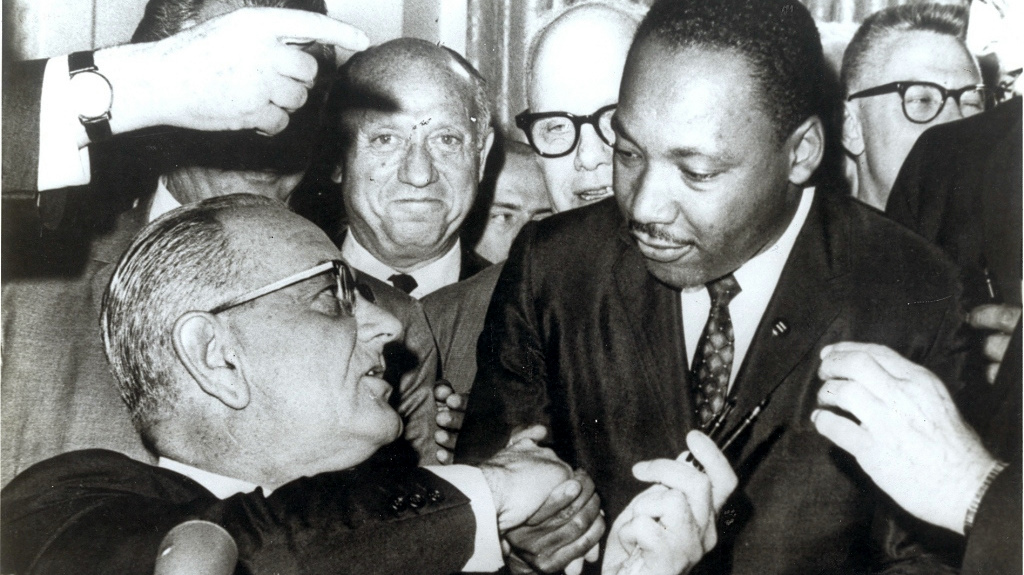
Citing the Rev. Dr. Martin Luther King Jr.’s famous “I Have A Dream” speech, given at the height of the civil rights movement in August of 1963, Raiford and Cohen question King’s mantra that all Americans will one day “not be judged by the colour of their skin but by the content of their character” and how it is being lived out today.
“By taking this quote out of context, King’s vision is of a colourblind society rather than an equitable one. Consciously developing since the Reagan era, colourblindness has since become the official racial ideology of U.S. neo-liberalism. Obama’s place as the first black president cements this narrative, seeming to affirm the dream of the United States as a colourblind or post-racial nation…. Could it be that because of the struggles of this heroic past, including the creation and celebration of Black History Month, we no longer need to celebrate Black History Month?”
Obscuring history?
But, the scholarly duo brings a larger problem to light, in noting that whether or not one agrees with earmarking February as the designated month to spotlight African American achievement in the U.S., “advertisers and political vote-getters” see an intangible value in capitalizing upon the event to push “lofty” agenda forward into the American psyche.
In example, JP Morgan Chase recently partnered with the King Center in Atlanta. The groups will work together to launch a website “preserving the inspiration and sharing the passion of Dr Martin Luther King, Jr”.
The move is being questioned, as some say it represents a form of revisionist history which functions to obscure relevant historical details and current trends which indicate that racism has not been overcome.
Commenting on the partnership Raiford and Cohen write, “This public relations enterprise belies the fact that Chase was one of the lending institutions that profited greatly from pushing subprime mortgages on African Americans, Latinos and other economically vulnerable U.S. citizens. And Chase continues to profit from the ongoing foreclosures of more than 3.5 million in the U.S. According to a November 2011 report from the Center for Responsible Lending, “one quarter of all Latino and African-American borrowers have lost their home to foreclosure or are seriously delinquent, compared to just under 12 per cent for white borrowers”.”
Potentially startling statistics
Blacks in America today still experience much discrimination. Some would even argue that in the decades since King delivered his famed speech, his vision still remains a dream deferred for many Blacks, who remain far likelier than Whites to be poor, jobless, uneducated and imprisoned.
While many black Americans have prospered since the civil right movements of the 1960’s, statistics indicate that there are still some stark contrasts between whites and people of color in the economic arena.
According to information from the Bureau of Labor Statistics, codified in the “State of the Dream 2011” report from Community Change, Inc., a nonprofit whose mission is to promote racial justice and equity by challenging systemic racism and acting as a catalyst for anti-racist learning and action – the unemployment rate was 15.8 percent among Blacks as of December 2010, which is as low as the unemployment rate during the Depression. Meanwhile, the unemployment rate for Whites was 8.5 percent.
In addition Blacks earn 57 cents for each dollar of White median family income, and while Blacks gained five cents to each White dollar of median family income from 1947 to1977, they gained only one cent in the 32 years since, the report revealed.
The poverty rate for Blacks is more than twice that of Whites, and childhood poverty rates for Blacks is more than three times that of White children.
Just two percent of Blacks earn $100,000 or more, as compared to 5.7 percent of Whites. At the other end, 33.8 percent of Blacks earn less than $10,000, as compared to 25.4 percent of Whites in the U.S.
In terms of wealth and assets, Blacks hold only 10 cents of net wealth for every dollar that Whites hold, and Blacks are 2.7 times as likely as Whites to have zero or negative net worth, and households in the wealthiest one percent (which is almost if not entirely comprised of Whites) now control 225 times the net wealth of the median household.
Raiford and Cohen conclude that the partnership between the King Center and Chase “reminds us of “the dream” while working to turn attention away from the historical King, a committed radical who denounced the U.S. government as ‘the greatest purveyor of violence in the world today’. A King who, at the end of his life, spearheaded the Poor People’s Campaign for the chronically impoverished, a movement that provides one of the many models for Occupy Wall Street today.”
“The Negro lives on a lonely island of poverty in the midst of a vast ocean of material prosperity,” King said at the beginning of his 1963 speech. Do King’s words still ring true today?