


Washington’s corridors of power have been busy in recent months dealing with the National Security Agency’s collection of private phone records and metadata, but that’s not the only issue of national security on federal officials’ radar.
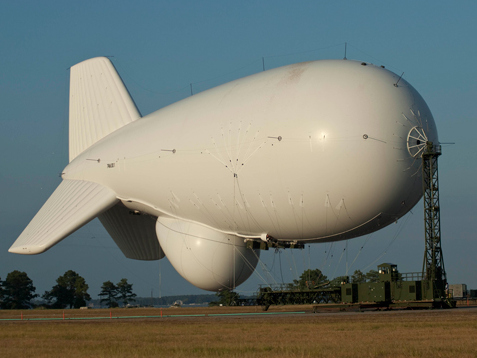
Envisioning scenarios of a 9/11-like terrorist attack on Washington, D.C., the U.S. Defense Department is upgrading its defense systems to include military spying blimps.
While the blimp is viewed by most of the world as a slow-moving, floating airship strewn with advertising messages, the Pentagon is making a few military modifications to create a house-sized flying fortress that can identify potential threats on the ground. Called the Raytheon JLENS system, these flying ships will be able to track incoming missiles, armed drones and other threats from hundreds of miles away with a 360-degree radius.
Perhaps its best selling point is that system can stay in the air for 30 days without refueling or stopping for supplies.
After successful trials in Utah, the Defense Department hopes to roll out the flying spy ship sometime in 2014. With over 100 soldiers trained on the system, the spy blimp has coped well with the spine-chilling terrorist war games that the Army used to test it. It is estimated that the Defense Department will spend up to 700 percent less on the spy-ship system than on spy planes, and it is believed to give better protection. But then again, the military does not have a great record on budgeting.
In a week where the U.S. House of Representatives voted for a Pentagon spending bill of $512 billion, Defense Secretary Chuck Hagel can move forward with his agenda of removing troops in Afghanistan and setting up special operations in the Middle East.
The bill would mean a $3.4 billion reduction in the Pentagon budget and $1.1 billion in savings from research and development budgets, but it would also force the 900,000 civilian Army employees around the world to take one day off per week. With this money being approved, can the Defense Department spend it wisely?
The Raytheon’s JLENS system will be one of the many Defense Department projects coming online in 2014, but we have been here before. Remember the failed military project of Lockheed Martin’s VH-71 aircraft? Hailed by the military as a much-needed update for the Air Force, the VH-71 went into development with an estimated cost of $4.2 billion. After delays and engineering issues, the cost ballooned to $11.4 billion. The Obama administration ditched the project in 2009.
Or the futurist CGX program, known the Next Generation Cruiser program. The U.S. Navy wanted to replace 22 Ticonderoga class cruisers in 2017 with this futuristic model. Original plans were for 18-19 destroyer ships with ballistic missile defense and air defense for a carrier group. With an estimated cost of $3.2 billion for just one ship, this program was also abandoned.
The development of defense programs like the Raytheon’s JLENS system will not be popular with many U.S. citizens who have been outraged by the NSA surveillance program. The Obama administration just narrowly survived the first major legislative challenge to the NSA’s bulk collection of phone records from millions of Americans. How will the public respond to further surveillance and a spy ship above their heads?