

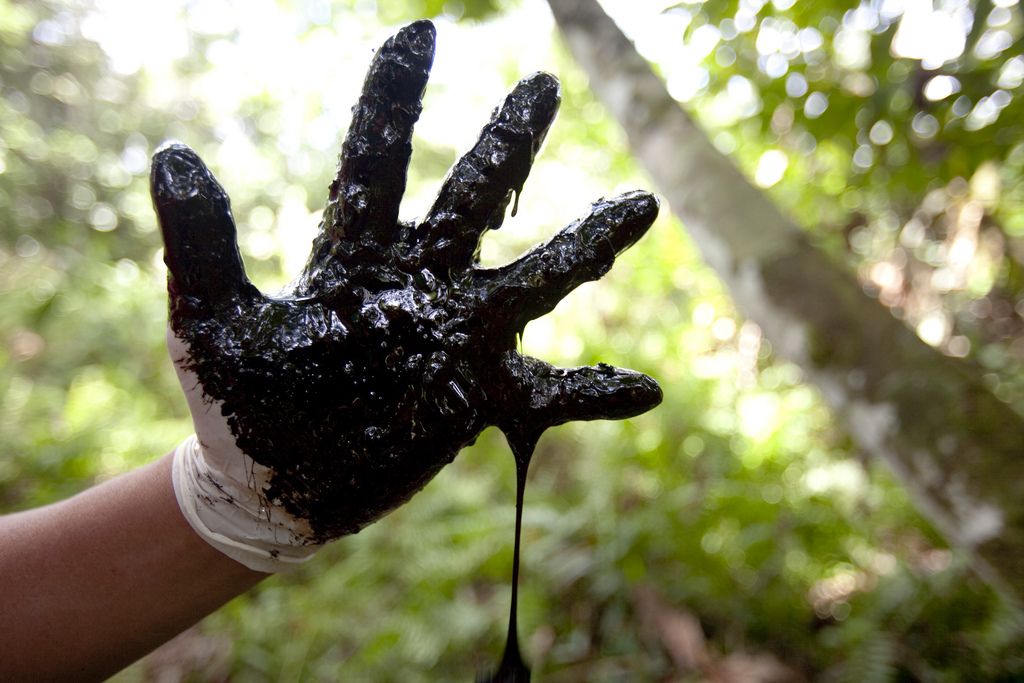

(MintPress)— 20 years after Ecuadoreans took big oil company Chevron to court over a massive oil disaster in the Amazon rain forest region that allegedly resulted in toxic land and water contamination, birth defects and cancer, Chevron defiantly announced this week that it will file an appeal to Ecuador’s National Court of Justice over the $18 billion ruling.
The fine would be cut to $8.6 billion if Chevron formally apologizes for the damages. Chevron inherited the almost 20 year-old lawsuit after buying Texaco Petroleum Co. in 2001.
Texaco was accused of intentionally dumping 18.5 billion gallons of toxic waste into streams and digging over 900 open-air, unlined waste pits from 1964-1992. A claim was filed in 1993 on behalf of 30,000 Indigenous Ecuadoreans against Texaco’s environmental injustices that allegedly resulted in toxic land and water contamination, high rates of birth defects, and leukemia among local communities.
Emergildo Criollo of the Indigenous Cofán people, discussed the effects of Texaco’s oil malpractices in the 2009 documentary, Crude. According to Criollo, water once was the life blood of the Cofán people, but now the water is contaminated so severely that animals have fled and people cannot survive. Criollo was living in the village when Texaco first entered the region.
Criollo says he lost two of his sons as a result of the oil. One son stopped developing six months after birth. The second son bathed and drank from the oil-contaminated river.
“We came back [from the river] and he started vomiting blood – he didn’t last 24 hours” said Criollo. “They came and spilled oil, contaminated the water and my children died.” Criollo’s story is one of thousands from the region.
Chevron claims there is no scientific support for the plaintiffs’ claims of social, health, and environmental harms. According to Chevron, “all of the legitimate evidence presented to the Ecuadorian court demonstrates that former Texaco Petroleum Company operations present no risk to residents’ health and have not resulted in any significant impact to groundwater, drinking water, biodiversity, or indigenous culture.”
.
Blame Game
Chevron instead believes that poor sanitation is the cause of the health problems in the Ecuadorean Amazon and places blame for any oil-related environmental conditions on Petroecuador, Ecuador’s state-owned oil company, which Chevron claims did not re-mediate its 62.5% ownership in the Texaco-Petroecuador consortium.
Chevron denies all allegations and is appealing the 2011 ruling based on charges against the plaintiffs’ lawyers. In a letter to the Prosecutor General of Ecuador, Chevron’s counsel, Thomas F. Cullen Jr., presented evidence marking the trial fraudulent and corrupt.
According to Cullen, “The previously submitted evidence proves that plaintiffs’ representatives covertly worked with the presiding judge, Nicolas Zambrano Lozado, to draft the judgment itself.” Chevron’s evidence is largely based off of outtakes from Joe Berlinger’s documentary, Crude, which he was court ordered to release in 2010.
The Amazon Defense Fund has made several similar charges of fraud and corruption against Chevron for interfering with the investigation. Most recently, in a press release on Monday, the Amazon Defense Fund reported that Chevron paid $2.2 billion to Diego Borja, a Chevron contractor who is believed to have swapped out contaminated water and soil samples during the investigation.
Until a final settlement is reached, Chevron will not be required to pay any of the money.
.
Worldwide Hypocrisy
Despite the decades-old Ecuador lawsuit and harsh criticism from various rights watch groups, Chevron continues to take pride in its socially responsible investments. In 2010, Chevron spent $197 million on community investments toward health, education, and economic development.
In response to Chevron’s annual Corporate Social Responsibility (CSR) report, Earth Rights International (ERI), a NGO combining the power of law and power of people in defense of human rights and the environment, published the True Cost of Chevron: An Alternative Annual Report.
The ERI report focuses on Chevron’s history of exploiting the environment, violating human rights, ignoring Indigenous communities, and using its wealth towards unjust political influence in the United States and countries around the world.
The 2008 Bowoto v. Chevron case was brought to American courts by four Nigerian plaintiffs who claimed Chevron hired Nigerian soldiers to shoot at Nigerians peacefully protesting the economic and environmental harm resulting from oil production in the Niger Delta in 1998.
Chevron claims that 150 Nigerians from the Concerned Ilaje Citizens (CIC) group took 100 workers hostage on an offshore oil platform. According to Chevron, members of CIC used violence and demanded money before they would release hostages.
The Court ruled in favor of Chevron. However, ERI believes “ the case has established and reinforced important rules supporting accountability of parent corporations for actions taken nominally by their foreign subsidiaries, and basic principles of international human rights law.”
Chevron faces similar allegations of supporting human rights and environmental abuses in several other countries including Kazakhstan, Myanmar, and the United States. Chevron denies accountability for these charges and claims to be continuously working towards the betterment of the communities in which it operates.
.
Ignoring the Real Problem
Chevron continues to place all blame for the existing environmental and health issues of oil malpractices in Ecuador on Petroecuador. Ecuadorean politicians and various rights watch groups continue to blame Chevron in response. The debate has been going on since Texaco left Ecuador in 1992 and is likely to continue for many years to come.
The heart of the issue however, is not about blame, but about justice. As Emergildo Criollo explained at an Annual Chevron Shareholders meeting, “I am not here to talk about laws and court cases. I am here to ask you to live up to your own words. I am here to save my people.”
Source: MintPress
.